


San Mai Steel: A Knifemaker's Guide to Blue Ridge, Wrought Iron and Copper SanMai

San Mai means "three layers." A hard steel core sits between two outer layers of a different material. When you grind the bevels, the core becomes the cutting edge and the outer layers stay on the flats. You get an edge steel that does the work, wrapped in a cladding chosen for looks, corrosion resistance or both.
At Baker Forge® we run two straight steel San Mai builds, Blue Ridge SanMai and Wrought Iron SanMai. Our copper laminates use the same core-and-cladding idea with copper Damascus on the outside. Here's how they compare and which one fits the blade you're building.
Blue Ridge SanMai: Hitachi Blue #2 in 410 Stainless

Blue Ridge SanMai is a solid three-layer build. The core is Hitachi Blue Paper #2 and the cladding is 410 stainless on both sides.
Blue #2 is a refined high-carbon steel with tungsten in it. Kitchen knife makers use it because it takes a very keen edge and responds well to heat treat. The 410 cladding keeps rust off the flats, which matters on a chef knife that lives next to a sink, and it grinds without fighting you.
Where the carbon core meets the stainless, you get a hazy carbon migration line that forms during forge welding. That line is the signature of this steel, and no two billets show it the same way.
Best for: chef knives, kitchen cutlery and other blades that need a fine edge with low-maintenance flats.
Wrought Iron SanMai: Antique Iron over a Steel Core
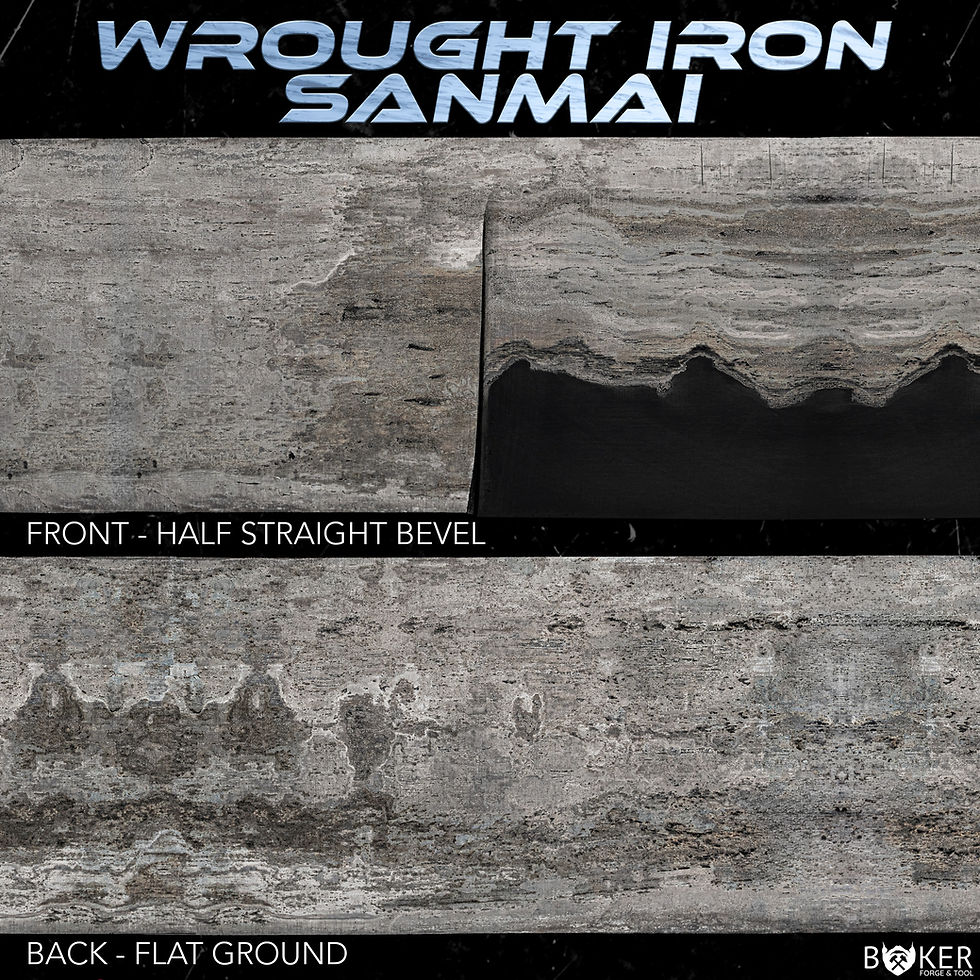
Wrought Iron SanMai puts genuine pre-1900 wrought iron on both sides of a solid high-carbon steel core. The iron comes from the rims of large antique wagon wheels. Many smiths consider wagon wheel iron the best wrought iron there is. The rims had to survive being heated, dropped over a wooden wheel and quenched tight, then decades of rough roads.
Wrought iron was made by hand in a puddling furnace. That process left fine, glassy slag fibers running all through the iron, and those fibers are what give it a wood grain look when etched. The last U.S. wrought iron plant closed in 1969, so what's still out there is all there is.
The steel core gets hard and holds an edge, so you get antique iron on the flats with a real working steel at the edge. Expect small slag spots now and then while grinding. That's normal for iron over 125 years old, and it doesn't affect the core.
Best for: hunters, bushcraft and camp knives, and any blade where the story and the grain matter as much as the edge.
Copper SanMai: CopperMai

CopperMai is our copper version of San Mai: copper Damascus cladding over a solid high-carbon steel core. The copper layers give the flats their color and contrast. The solid core is what makes it a blade steel, because the edge is all steel.
That's the key difference from Coppermascus®. Coppermascus is copper Damascus with no solid core, so we use it as a cladding material, not as a blade by itself. We'll cover that in its own guide.
Best for: EDC and kitchen knives where the cladding is the showpiece.
Quick Comparison
Blue Ridge SanMai: Hitachi Blue #2 core, 410 stainless cladding. Hazy carbon migration line. Flats resist rust. Best for kitchen knives.
Wrought Iron SanMai: high-carbon steel core, pre-1900 wrought iron cladding. Wood grain. Flats need care like carbon steel. Best for hunters, camp and bushcraft knives.
CopperMai: high-carbon steel core, copper Damascus cladding. Copper contrast. Flats need care like carbon steel. Best for EDC and kitchen knives.
Heat Treat: Aim at the Core
With any San Mai, you heat treat for the core steel. The cladding goes along for the ride. Heat treat at full thickness before grinding bevels.
Every steel we sell has its own heat treat spec sheet with the full recipe, from normalizing through quench and temper. Find the sheet for your exact steel on our Heat Treat page and follow it. Cores can change from one run to the next, so always go by the sheet for the bar you bought.
Etching
Etching is where San Mai shows off. Clean the blade with Grime Reaper first so oils don't leave blotches.
Wrought Iron SanMai: Gator Piss® Heavy. A light etch gives bright, shiny grain, and a deep etch gives a true wood grain texture.
Blue Ridge SanMai: Gator Piss Heavy brings out the core line against the 410.
CopperMai: Gator Piss Heavy. If the bar has 1084/15N20 Damascus in it, use Gator Piss Original instead, which keeps the Damascus pattern crisp.
Finish with Gator Skin® to seal the etch. Find all three on our Gator Piss page.
Buying San Mai from Baker Forge
Every bar is pictured as the exact bar you'll receive, priced by size. If you need a billet rolled thinner before it ships, add Billet Services to your cart with it. All of our billets are steel only, not finished knives.


Comments